
Scottish Wedding Traditions Explained
Handfasting, the quaich, the ceilidh and more, explained by a luxury planner
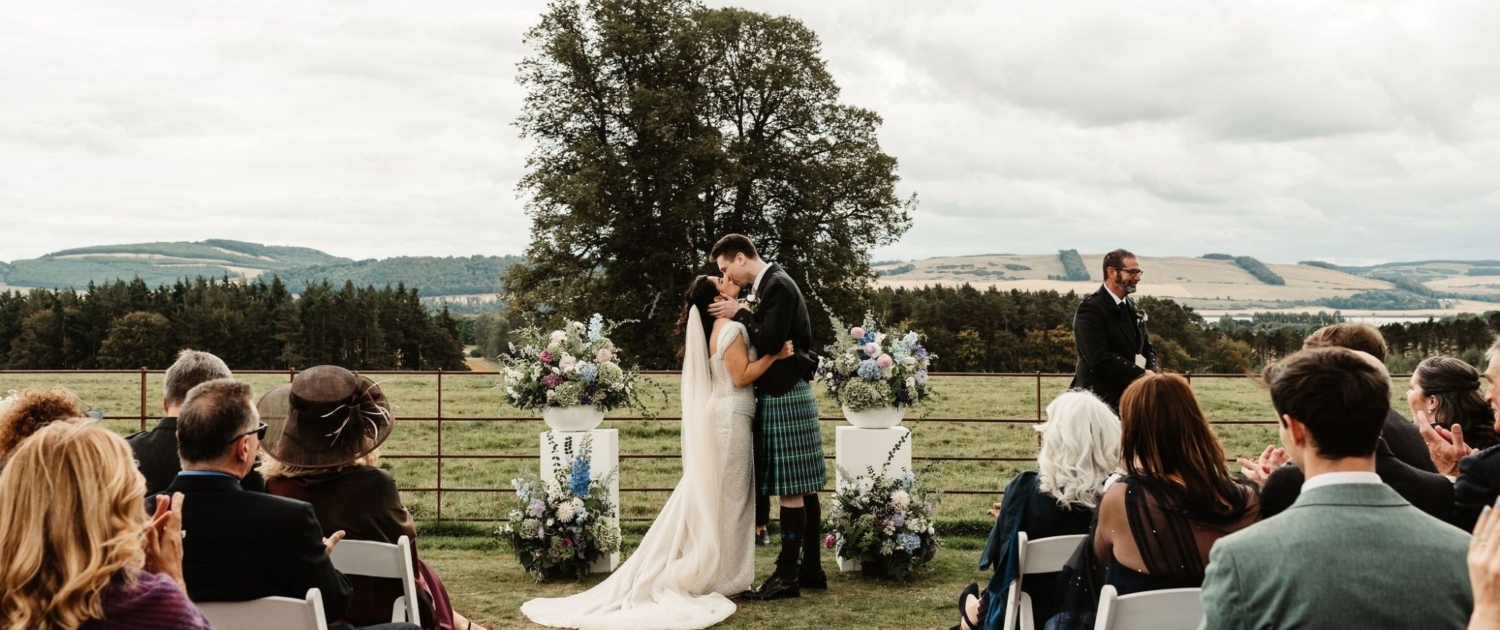
Scottish wedding traditions blend Celtic heritage, folklore, family and symbolism into some of the most meaningful rituals in the wedding world. Some are solemn, such as handfasting and sharing from the quaich. Others are gloriously playful, such as the blackening and the scramble. You do not need to be Scottish to include them, and you do not need to include all of them. The best weddings choose a few that carry real meaning.
This guide explains each traditional Scottish wedding custom, what it means, how it is pronounced and how couples weave it into a modern day.
Crafted with Care. Delivered with Distinction.
The main Scottish wedding traditions at a glance
| Tradition | What it is | What it means | Say it as |
|---|---|---|---|
| Handfasting | The couple’s hands are bound with ribbon or tartan | Union; the origin of the phrase “tying the knot” | hand-fasting |
| The quaich | Sharing a drink from a two-handled cup | Trust and the joining of two families | kway-ch |
| Luckenbooth brooch | A silver brooch of two entwined hearts | A love token, later a charm for the first child | luck-en-booth |
| Oathing stone | Hands placed on a stone during the vows | Vows “set in stone” | oath-ing |
| The scramble | The groom throws coins for children to gather | Good fortune and generosity | scramble |
| Sixpence in the shoe | A silver coin tucked into the bride’s shoe | Prosperity | six-pence |
| The blackening | Friends cover the couple in messy substances | Warding off bad luck; testing resilience | blackening |
| The ceilidh | Lively traditional Scottish dancing with a band | Community and celebration | kay-lee |
| Tartan and kilts | Clan tartan worn by the couple and guests | Heritage and welcome into a family | tar-tan |
| The piper | Bagpipes lead the processions | Announcing and honouring the day | piper |
Handfasting: the origin of “tying the knot”
Handfasting is the best known Scottish wedding tradition, and an ancient Celtic one. The couple’s hands are bound together with a ribbon, cord or strip of tartan, and as they draw their hands apart, the binding forms a knot. This is the literal origin of the phrase “tying the knot.”
In Scotland, handfasting can be woven into the legal ceremony itself, which is part of why it has surged back into popularity. Couples often use a ribbon in their clan tartan, or something personal, and keep the knotted cloth as a keepsake afterwards.
The quaich: the loving cup
The quaich (say kway-ch) is a shallow, two-handled “loving cup.” During the ceremony the couple take turns sipping from it, traditionally a dram of whisky, to toast their new life together.
The two handles carry the meaning: both people hold the cup with both hands, a gesture of trust that historically showed neither party was concealing a weapon, and a symbol of two families, or clans, coming together. The quaich is one of the easiest traditions to include and one of the most photogenic.
The luckenbooth brooch
The luckenbooth is one of Scotland’s oldest love tokens: a silver brooch of two intertwined hearts, often beneath a crown. Traditionally the groom gives it to the bride as a symbol of love and loyalty, rather like an early engagement gift.
Its second life is the loveliest part: the brooch is later pinned to the couple’s first child’s blanket as a charm of protection, passing love and luck down a generation.
The oathing stone
With the oathing stone, the couple place their hands on a stone while speaking their vows, so their promises are literally “set in stone.” The custom has Celtic and pagan roots, and couples often choose a stone from a place that means something to them, then keep it in their home afterwards.
The scramble and the sixpence
Two traditions invite good fortune through coins.
The scramble (also called the warsel or scoor oot): as the couple leave, the groom or the bride’s father throws a handful of coins for the children present to gather. It represents generosity and prosperity shared with the community.
The sixpence in the shoe: a silver sixpence is tucked into the bride’s shoe, traditionally by her father, for prosperity. It completes the old rhyme, “something old, something new, something borrowed, something blue, and a silver sixpence in her shoe.”
The blackening: the messy one
The blackening is the most riotous Scottish tradition, and mostly a rural one. In the days before the wedding, friends ambush the bride, the groom or both and cover them in soot, flour, treacle, feathers and worse, then parade them around the community.
Beneath the mischief is real meaning: if the couple can survive the blackening with humour, they can survive anything married life brings. It is also said to ward off bad luck.
The ceilidh: how Scots celebrate
No traditional Scottish wedding is complete without a ceilidh (say kay-lee), an evening of lively social dancing led by a live band and a caller who teaches the steps. Everyone dances, from the youngest guest to the oldest, which makes the ceilidh the warm, joyful heart of the reception. Many weddings open with a Grand March that brings the whole room to its feet.
Tartan, kilts and the piper
Dress and music carry as much tradition as the rituals.
Kilts and tartan: the groom and often all the men wear kilts in their clan tartan. The bride frequently wears the groom’s clan tartan, as a sash, shawl or tie, to symbolise being welcomed into a new family.
The piper: a bagpiper traditionally pipes the bride in, leads the wedding party and announces the meal, giving the day its unmistakable Scottish soundtrack.
Do you have to be Scottish to include these traditions?
No. Couples travel from around the world to marry in Scotland, and Scottish wedding traditions are welcoming rather than exclusive. The guidance we give couples is simple: choose the customs that connect to you, your family or your setting, and make sure guests understand what is happening. A single, well-explained tradition means more than a checklist of ten.
This is a lovely part of planning a wedding here, and one we help couples from the US, Canada and beyond weave into their day with authenticity rather than cliché.
Ready to plan a Scottish wedding of your own? Read our complete guide to getting married in Scotland, explore our Scottish venues and destinations, consider an intimate elopement, or start planning with us.
Frequently asked questions
What are the main Scottish wedding traditions?
The best known are handfasting (binding the hands), sharing from the quaich (a two-handled cup), the luckenbooth brooch, the oathing stone, the scramble and sixpence for luck, the blackening, and the ceilidh dancing, alongside tartan, kilts and a piper.
What is handfasting?
Handfasting is an ancient Celtic ritual in which the couple’s hands are bound with ribbon or tartan. As they pull apart, the cloth forms a knot, which is the origin of the phrase tying the knot. In Scotland it can form part of the legal ceremony.
What is a quaich and how do you use it?
A quaich (kway-ch) is a shallow, two-handled loving cup. The couple take turns sipping a drink, usually whisky, from it to toast their marriage. The two handles symbolise trust and the joining of two families.
What is the blackening?
The blackening is a playful pre-wedding tradition in which friends cover the bride or groom in messy substances such as soot and treacle, then parade them. It is meant to ward off bad luck and prove the couple can withstand anything together.
What is the wedding scramble?
As the couple leave, the groom or the bride’s father throws coins for children to gather, symbolising good fortune and generosity shared with the community.
Do you have to be Scottish to include Scottish wedding traditions?
No. Anyone marrying in Scotland can include these customs. The key is to choose the ones that hold genuine meaning for you and to explain them to your guests.