
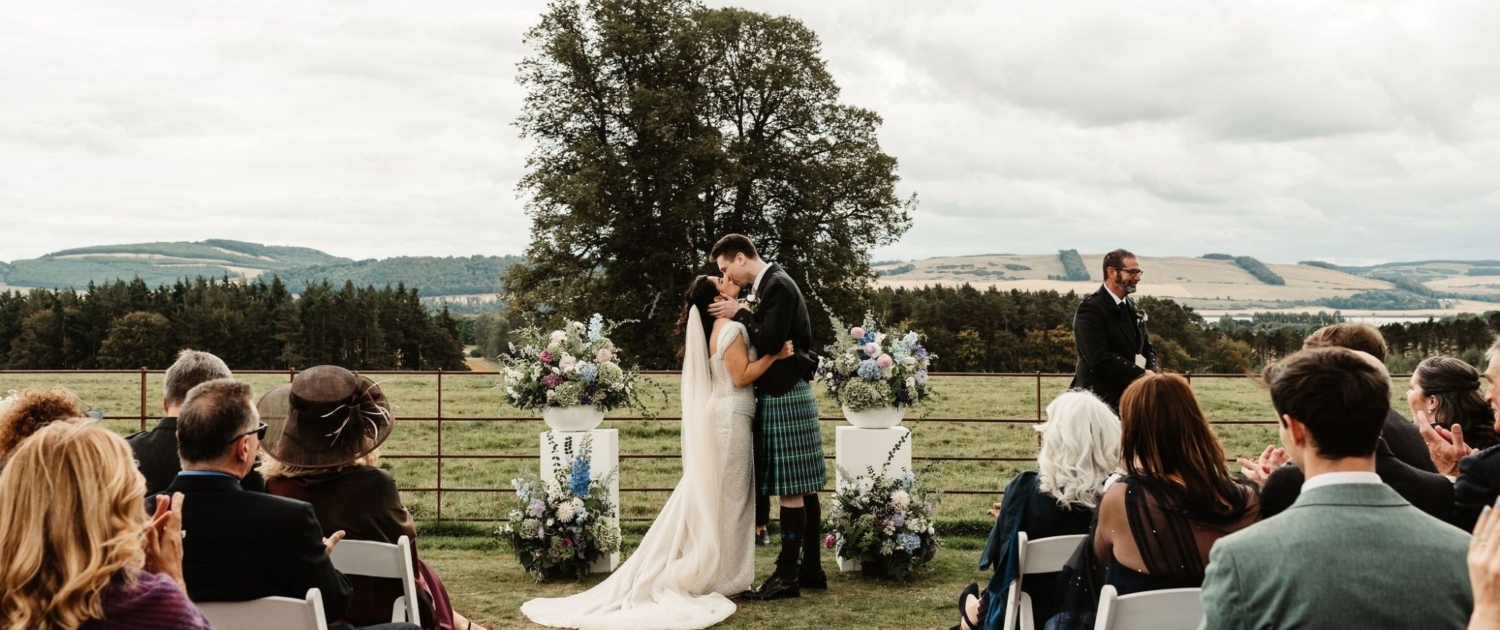
Getting married in Scotland is refreshingly simple, and more flexible than almost anywhere else in the UK. Any two people aged 16 or over can marry here, there is no residency requirement, and you can hold a legally binding ceremony almost anywhere: a castle, a Highland glen, a loch shore or a city townhouse. Couples travel from the United States, Canada and beyond to marry in Scotland every year, and their Scottish marriage certificate is recognised back home.
This guide sets out exactly how to get married in Scotland, what it costs, how long it takes and where you can do it, written by a planner who has guided couples through it for nearly two decades.
Scotland also offers some of the most meaningful Scottish wedding traditions, from handfasting and the quaich to the ceilidh, which couples can weave into the day.
Crafted with Care. Delivered with Distinction.
Can you get married in Scotland if you live abroad?
Yes. There is no general residency requirement for marriage in Scotland. You do not need to live in Scotland before your wedding, and you do not need to arrive weeks early. You give notice by post or through your chosen district registrar, arrive for your celebration, marry with two witnesses, and receive your certificate afterwards. For the full paperwork, see our guide to the marriage licence in Scotland and the M10 form. For couples in the US and Canada, this is the single most important fact: Scotland is genuinely open to you. See our dedicated guide to getting married in Scotland as an American.
Why couples choose to get married in Scotland
A few features set Scotland apart, and they matter whether you are planning a grand castle wedding or an intimate elopement:
- You can marry almost anywhere. Scotland does not tie legal ceremonies to approved premises. A clifftop, a walled garden, a castle great hall or a loch shore can all be your ceremony spot.
- Humanist and belief ceremonies are legally binding. Scotland is one of the few parts of the UK where a humanist or other belief ceremony is the legal marriage, with no separate civil registration required.
- No residency requirement. You can plan entirely from abroad.
- Same-sex marriage is legal and has been since 2014.
- The setting. Around 1,000 castles and estates, dramatic Highland scenery, and a deep tradition of hospitality.
How to get married in Scotland: the legal steps
The legal process is administered by National Records of Scotland through local district registrars. The core document is the M10 marriage notice form. Here is the sequence.
- Choose your date, venue and celebrant. In Scotland the venue is not restricted by law, so this is where your vision leads rather than a licensing list.
- Complete an M10 marriage notice form each. Both partners submit an M10 to the registrar for the district where the wedding will take place, not where you live.
- Send the supporting documents (see the table below), including, for US and Canadian couples, a Declaration of Status by Non-UK National.
- Mind the timing. The earliest you can submit is three months before; the legal minimum is 29 days before. National Records of Scotland advises submitting 10 to 12 weeks ahead, which is the safe window for couples abroad.
- The registrar prepares your marriage schedule. For a religious or belief ceremony, either you or your partner must collect the schedule in person before the wedding. For a civil ceremony the registrar brings it.
- Marry with two witnesses aged 16 or over, and sign the schedule.
- The schedule is registered and your marriage certificate is issued shortly after.
What you need to get married in Scotland
| Document | Who provides it | Notes |
|---|---|---|
| M10 marriage notice form | Each partner | The core legal notice |
| Birth certificate (original) | Each partner | Certified translation if not in English |
| Passport | Each partner | Required if born after 1 January 1983 |
| Proof of address | Each partner | Driving licence, council tax bill or recent utility bill |
| Declaration of Status by Non-UK National | Non-UK nationals | Required for US and Canadian couples |
| Divorce decree or death certificate | If previously married | Proof you are free to marry |
| Witness details form | For your two witnesses | Witnesses must be aged 16 or over |
Your legal timeline at a glance
| When | Step |
|---|---|
| 6 to 12 months before | Secure your date, venue and celebrant |
| 3 months before (earliest) | Submit your M10 notice forms to the district registrar |
| 10 to 12 weeks before (recommended) | The safe submission window, especially from abroad |
| 29 days before (latest) | The absolute legal minimum for notice |
| Before the ceremony | Registrar prepares the schedule; for religious or belief ceremonies you collect it in person |
| On the day | Marry with two witnesses aged 16+ and sign the schedule |
| After | The schedule is registered and your certificate is issued |
Getting married in Scotland as an American or Canadian
This is the question we are asked most, so here is the clear version.
- Nationality is no barrier. Any two people, regardless of where they live, may marry in Scotland.
- No residency and no visa to marry. You do not need to be resident, and there is no waiting period after you arrive. (Immigration status is separate from the right to marry; most couples travel on the standard visitor basis for the celebration itself. Confirm your own entry requirements before travelling.)
- One extra form. Non-UK nationals complete a Declaration of Status by Non-UK National alongside the M10.
- Your marriage is recognised at home. The United States and Canada recognise a marriage legally performed in Scotland. Your Scottish certificate is your proof; you do not remarry when you return.
- Practical tip. Submit your notice 10 to 12 weeks ahead and send documents by tracked post. You will present originals before the ceremony.
This is the heart of what we do: managing every one of these steps for couples who are thousands of miles away.
Scotland compared with England and Wales
If you have read about marrying in England, Scotland’s rules are notably more open. This is why so many couples choose it.
| Aspect | Scotland | England and Wales |
|---|---|---|
| Where you can legally marry | Almost anywhere: castle, glen, loch, beach or garden | Traditionally restricted to approved premises and registered religious buildings |
| Humanist and belief ceremonies | Legally binding on their own | Not legally binding by themselves; a separate civil registration is needed |
| Minimum age | 16, without parental consent | 18 |
| Notice period | Minimum 29 days (submit 10 to 12 weeks ahead) | Minimum 28 days |
| Residency to marry | None | None for the marriage, though notice is given in your district |
Types of wedding ceremony in Scotland
You have three routes to a legal marriage, and all three are equally valid in law.
| Ceremony | Conducted by | Legally binding | Character |
|---|---|---|---|
| Civil | A registrar | Yes | No religious or belief content; held at the registration office or a venue you agree |
| Religious | A minister, priest or other religious celebrant | Yes | Any location agreed with the celebrant |
| Belief (e.g. humanist) | An authorised belief celebrant | Yes, a Scottish distinction | Personalised and non-religious, written around your story |
Humanist weddings in Scotland deserve a special mention: they are hugely popular precisely because they are both deeply personal and fully legal, which is not the case in England and Wales.
Where can you get married in Scotland?
Almost anywhere you like. Because Scots law does not restrict legal ceremonies to approved premises, your options are unusually broad:
- Castles and estates for exclusive-use celebrations
- The Highlands, Isle of Skye and lochsides for dramatic scenery
- Edinburgh and St Andrews for city and coastal elegance
- Private gardens and outdoor settings, since outdoor weddings are entirely legal here
We plan weddings across Scotland, from castle weekends to intimate Highland elopements. Explore our Scottish destinations, featured venues and elopement packages.
What does it cost to get married in Scotland?
The legal cost of marrying in Scotland is modest and set by the Registrar General. The wider celebration cost (venue, catering, styling, planning) is separate and varies widely by the type of wedding.
| Item | Typical cost | Notes |
|---|---|---|
| Marriage notice fee (M10) | Around £45 to £50 per person | Set nationally; varies slightly by council |
| Registrar attending a venue | Varies by council | Higher than a ceremony at the registration office |
| Marriage certificate | A small per-copy fee | Confirm the current amount with the council |
Figures are indicative and set locally, so please confirm current fees with the relevant council. For a full breakdown of celebration costs, see our forthcoming Scotland wedding cost guide.
When is the best time to get married in Scotland?
There is no wrong season, only different moods.
- Late spring and early summer (May to July) bring the longest days and the greenest landscapes.
- Autumn (September to October) offers golden light and dramatic colour, a favourite for photography.
- Winter delivers cosy castle interiors, firelight and the chance of snow.
Scottish weather is changeable in any season, which is why an experienced planner always builds in a considered wet-weather plan.
How a planner makes marrying in Scotland effortless
For couples planning from abroad, the value of a planner is not luxury for its own sake, it is certainty. We manage the M10 process and registrar liaison, coordinate every supplier, arrange virtual venue tours, work around your time zone and remove the guesswork of marrying in a country you may not yet have visited.
With nearly two decades of experience and more than 1,000 weddings planned, we specialise in exactly this: bringing US, Canadian and international couples to Scotland for a day that feels seamless from first enquiry to final dance.
Frequently asked questions
Can you get married anywhere in Scotland?
Almost anywhere. Scotland does not limit legal ceremonies to approved premises, so you can marry in a castle, a glen, by a loch, on a beach or in a garden, as well as at a registration office.
What age can you get married in Scotland?
Both people must be at least 16 years old on the day of the wedding. Unlike England and Wales, no parental consent is required.
Do you need witnesses to get married in Scotland?
Yes. You need two witnesses aged 16 or over, and their details are provided before the wedding.
How long does it take to get married in Scotland?
You must give notice using the M10 form at least 29 days before the wedding, and no earlier than three months before. National Records of Scotland recommends submitting 10 to 12 weeks ahead.
Can Americans or Canadians get married in Scotland?
Yes. There is no residency requirement and no restriction based on nationality. Non-UK nationals complete a Declaration of Status by Non-UK National alongside the M10, and the marriage is recognised in the US and Canada.
Do you need to live in Scotland to get married there?
No. There is no general residency requirement, so you can plan entirely from abroad.
Can you have a humanist wedding in Scotland?
Yes, and it is legally binding. Scotland is one of the few parts of the UK where a humanist or belief ceremony is the legal marriage in its own right.
How much does it cost to get married in Scotland?
The statutory marriage notice fee is around £45 to £50 per person, set by the Registrar General and varying slightly by council. Venue, catering and other celebration costs are separate.
Is a Scottish marriage recognised in the US and Canada?
Yes. A marriage legally performed in Scotland is recognised in both countries, and your Scottish marriage certificate is your proof.